
Table of Contents
Last Updated on February 24, 2025 by Beverly Dix

NSAIDs – Say, What’s That Name?
Chronic NSAID use is dangerous. But, oh, let’s start from the beginning. The letters N-S-A-I-Ds stand for nonsteroidal anti-inflammatory drugs. NSAIDs can relieve pain, decrease inflammation, and reduce fevers. If you’ve ever had a cold, flu, headache, menstrual cramps, arthritis or joint pain, chances are you took a nonsteroidal anti-inflammatory medication. Therefore, NSAIDs are among the top three most often used classes of drugs in the United States.

So, NSAIDs are a go-to remedy, for minor aches and pains. Those resulting from short-term bodily discomforts. Where the end of pain is in sight. Cool! For menstrual cramps, colds, flu and headaches, NSAIDs are both safe and effective. We can have pain one moment, pop a pill, and soon be ready to roller skate, hike, or ride a bike. At least that’s what the NSAID marketers want consumers to believe. But problems enter this sunny pharmaceutical horizon for people battling arthritis, joint pain, and stiffness.
For people with chronic inflammation, NSAIDs are often an intimate and integral part of their daily lives. And, in a lot of cases, a dangerous one. To understand the risks of long-term nonsteroidal anti-inflammatory use, it’s critical to know how these drugs work.
How Do NSAIDs Work?
Let’s start with basic concepts and definitions. We’ll build from there.

Start at the top of my simplified diagram…And let me say, this is a scientifically incomplete drawing. Its purpose? To illustrate my points. Understand the basics of the arachidonic acid pathway, and decisions you make about when and if to take NSAIDs will truly be informed.
Definitions:
Arachidonic Acid.
An omega-6 polyunsaturated fatty acid (PUFA) present in most animal fats. Needed for normal health, arachidonic acid (AA) plays an important role in cell membrane function and cell communication, particularly in the central nervous system, musculoskeletal system, and immune system. AA is found in eggs, poultry, animal organs, meat, fish and seafood, and in linoleic acid from seed oils (e.g., corn, canola, safflower, sunflower, peanut, grapeseed and soybean).
COX Enzymes.
COX (all caps) stands for cyclooxygenase, a type of protein. There are three different COX enzymes, but the ones we will look at are called COX-1 and COX-2. COX-1 and COX-2 enzymes convert arachidonic acid into fatty substances called prostaglandins.
Prostaglandins.
Desirable Prostaglandin Effects.
We won’t get too technical. However, it’s important to know prostaglandins are responsible for critical functions in our bodies. Consequently, prostaglandins signal to cells and tissues to take action under specific conditions. Therefore, they are active substances.
For example, prostaglandins are in charge of immune system surveillance and defense. They regulate body temperature, and protect the tissues lining our stomachs and intestines. As well, prostaglandins influence the sleep-wake cycle, reproduction, dilation and constriction of our blood vessels. They are responsible for the kidneys’ ability to maintain proper fluid balance, and activation and prevention of blood clotting. This is a partial list of the “desirable” physiologic functions of prostaglandins.
Undesirable Prostaglandin Effects.
Prostaglandins control levels of inflammation and pain. For example, under normal circumstances, your body starts an inflammatory reaction to repair and resolve injury and/or infection. However, there is a problem if your body activates an inflammatory defense when there is no recent injury or infection. Your system remains at a “slow burn” for no apparent reason.
Constant overproduction of inflammatory prostaglandins increases pain sensitivity and is undesirable. Moreover, it is a scientific fact that chronic inflammation can trigger cancer, arthritis, stroke, diabetes, central nervous system diseases, and heart disease.
Nonselective vs. Selective NSAIDs.
COX-1 and COX-2 enzymes break down arachidonic acid into prostaglandins. Now, since NSAIDs work by inhibiting the activity of COX enzymes, they reduce production of prostaglandins. NSAID blockade is either nonselective or selective.
As noted in the diagram, nonselective NSAIDs block the activity of COX-1 and COX-2 enzymes. This results in reduction of prostaglandins responsible for pain, inflammation and fever. But remember? Prostaglandins also protect the lining of the stomach and intestines, maintain proper kidney function, and affect blood vessels and arteries. Therefore, regularly taking nonselective NSAIDs will decrease the prostaglandins that protect your gastrointestinal tract and influence how cells function in your kidneys, heart, and brain.
Referring to the diagram noted above, scientists developed drugs to selectively inhibit COX-2. Their hypothesis was that inhibition of the COX-2 enzyme would dramatically decrease the production of prostaglandins that cause inflammation and pain. At the same time, gastrointestinal risks for bleeding, ulcers, and obstruction would be minimized.
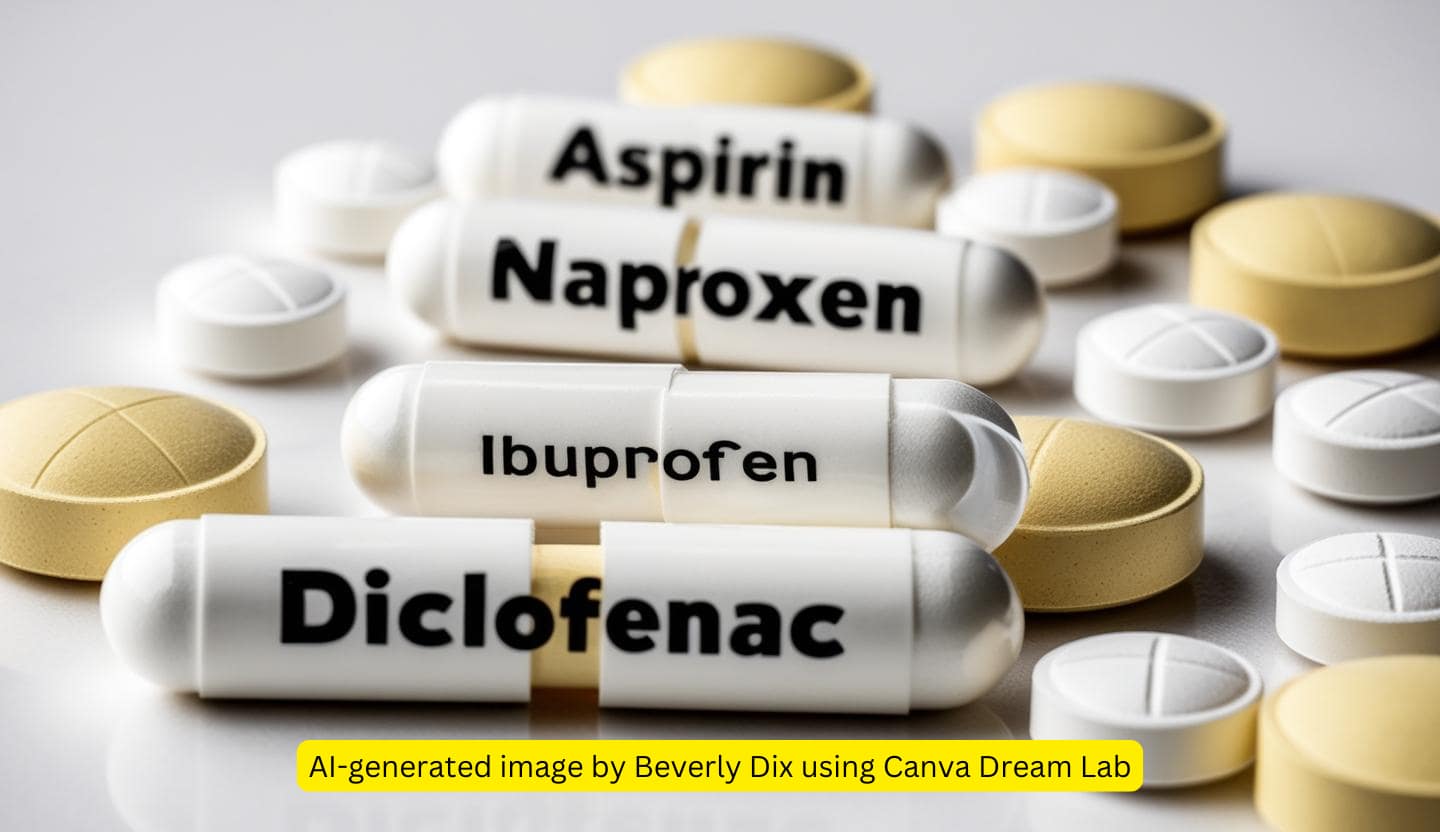
All NSAIDs on the market today in the United States are nonselective except for one. A partial list includes: meloxicam (Mobic/Vivlodex); diclofenac (Voltaren gel/Cataflam); naproxen (Aleve, Anaprox, Naprosyn); ibuprofen (Advil, Motrin, Midol); indomethacin (Indocin); aspirin. Celebrex, generically called celecoxib, is the only selective NSAID or COX-2 inhibitor for sale in the United States today.
Chronic NSAID Use: Harmful Side-Effects.
Gastrointestinal.
Upper gastrointestinal tract side-effects of nonselective NSAIDs include heartburn, nausea, and mild ulcers. As well, sometimes more serious bleeding ulcers require surgical treatment.
Furthermore, gastroenterologists can now view the small intestine when a wireless camera placed inside a small capsule is swallowed by their patients. Due to this advanced imaging technique, it is estimated 75% of patients who chronically take NSAIDs have damage in the lower GI tract. Of note, these patients may not experience symptoms. Moreover, the use of proton pump inhibitors does not decrease the risk of injury to the lower bowel. Furthermore, there is mounting evidence that proton pump inhibitors increase the risk of small bowel damage.
Gastroenterologists suspect increased permeability of the gastric lining due to NSAID use disrupts the gut microbiome. In some patients this leads to problems like bacterial overgrowth, constipation, or irritable bowel syndrome.
Cardiovascular.
Non-aspirin NSAIDs increase your risk of having a heart attack or stroke. The risk of heart attack is reported to peak within 7 to 10 days of NSAID use.
NSAIDs have been found to increase blood pressure. They interact with anticoagulants, aspirin, ACE inhibitors, ARBs, and diuretics.
Blood.
Aspirin can thin your blood and cause excessive bleeding 7 to 10 days following the last dose.
Kidneys.
NSAIDs should be avoided by people with prior kidney disease, low fluid volume, and low blood pressure. They can cause acute renal failure, fluid retention, and hypertension.
Hypersensitivity Reactions.
The most common hypersensitivity reaction is NSAID-exacerbated respiratory disease. Symptoms include a runny nose (rhinitis), nasal polyps, sinusitis, and asthma. Skin reactions, for example, can include rashes, hives, blistering, itching or swelling.
Preventing NSAID Misuse.
Know the Risks of Chronic NSAID Use.
Due to marketing, prescribing practices, and over-the-counter (OTC) availability NSAIDs are among the most widely used classes of drugs sold in the United States. Consequently, the general public’s attitude seems to be, “If everyone takes NSAIDs, they must be harmless.” Nothing could be further from the truth.
All NSAIDs except aspirin increase the risk of heart attack, heart failure, and stroke. In 2015, the FDA strengthened its “black box” warning regarding the risks associated with NSAID use. This increase in risk includes people who have heart disease and those who don’t. However, the risk is greater in those who have heart disease.
Anyone suffering from chronic joint pain and stiffness due to arthritis or a connective tissue disorder, as I do, must free themselves from the unrealistic notion you will ever be pain free. If you believe, as I once did, nonsteroidal anti-inflammatory drugs are a viable treatment option that will lead to a better quality of life, then you have a serious misunderstanding about the long-term consequences of these medications.
Correct Dosing & Duration.
Recommendations given in conventional medical literature for the safe use of NSAIDs are as follows.
- Use NSAIDs only if needed.
- Understand how to take the medication.
- Know the possible side-effects and drug interactions.
- Take the lowest dose for the shortest duration due to the risks associated with NSAIDs.
Rethinking Chronic NSAID Use.
Your experience of pain directly relates to mood and emotions. While addressing stressors and mental health issues, many people successfully manage their chronic inflammation and pain with dietary choices. For example, reducing intake of foods containing arachidonic acid can help.
I combine dietary strategies with supplements, and body and mind work. In this way, I only take NSAIDs during flares and have been able to successfully manage my autoimmune inflammatory issues. I will share more about my journey in the weeks to come.
Summary: Is Chronic NSAID Use Right For You?
- NSAIDs are chronically used for arthritis, joint pain, and stiffness.
- NSAIDs block COX enzymes.
- COX enzymes break down arachidonic acid from food into prostaglandins.
- Prostaglandins cause pain and inflammation. But prostaglandins are also necessary for proper stomach, heart, brain, and kidney function.
- NSAIDs block COX enzymes, which reduces levels of inflammatory prostaglandins, but also those prostaglandins needed for proper stomach, heart, brain, and kidney function.
- The United States Food and Drug Administration warned in 2015 that non-aspirin NSAID use for 7-10 days increases EVERYONE’s risk of heart attack, stroke, and heart failure.
- NSAIDs should be taken in the smallest effective dose and for the least amount of time.
- Given the risks of heart attack, stroke and heart failure, is long-term NSAID use for the treatment of joint pain, stiffness, and arthritis right for you?
- Attention to mood, emotions, diet, exercise and supplements provides viable NSAID alternatives for the management of chronic joint pain, stiffness, and arthritis.