
Table of Contents
Last Updated on March 10, 2025 by Beverly Dix
In a Wall Street Journal article, “Why We Don’t Trust Doctors Like We Used To,” Clare Ansberry notes:
“Trust in doctors is more important than ever given the aging U.S. population.”
I disagree.
The Erosion of Trust in Doctors
Once upon a time, most of us viewed doctors as reliable, believed they possessed integrity, and had faith in their competence based on the comparatively high level of education they attained and the oath each swore to do no harm. Physicians enjoyed the benefits of social trust and, through their work with patients one-on-one, developed interpersonal trust.
Our family’s pediatrician throughout my childhood and into adulthood comes to mind—Dr. Joseph Yarris of Oakland, California. He took time to get to know my parents and each of the children in our family, the schools we attended, and the extracurricular activities we enjoyed. His office waiting room seemed always brimming with patients. Yet the handsome, charming Dr. Yarris (yes, I adored him) and staff never appeared rushed, impatient, or rude.
Because of the respect Dr. Yarris showed us, actively listening and not giving our communications short shrift, we willingly accepted his advice and guidance—and if not, we freely let him know.
Managed Care and the Profit-Driven Healthcare System
In “What I Wish I Knew in Residency About Private Practice,” Dr. Daniel E. Choi (Choi’s interview, 2024, as cited by Smith, 2024) points out that the goal of managed care in today’s world, where corporations and private equity firms have taken over a huge share of the healthcare system, is to maximize profit.
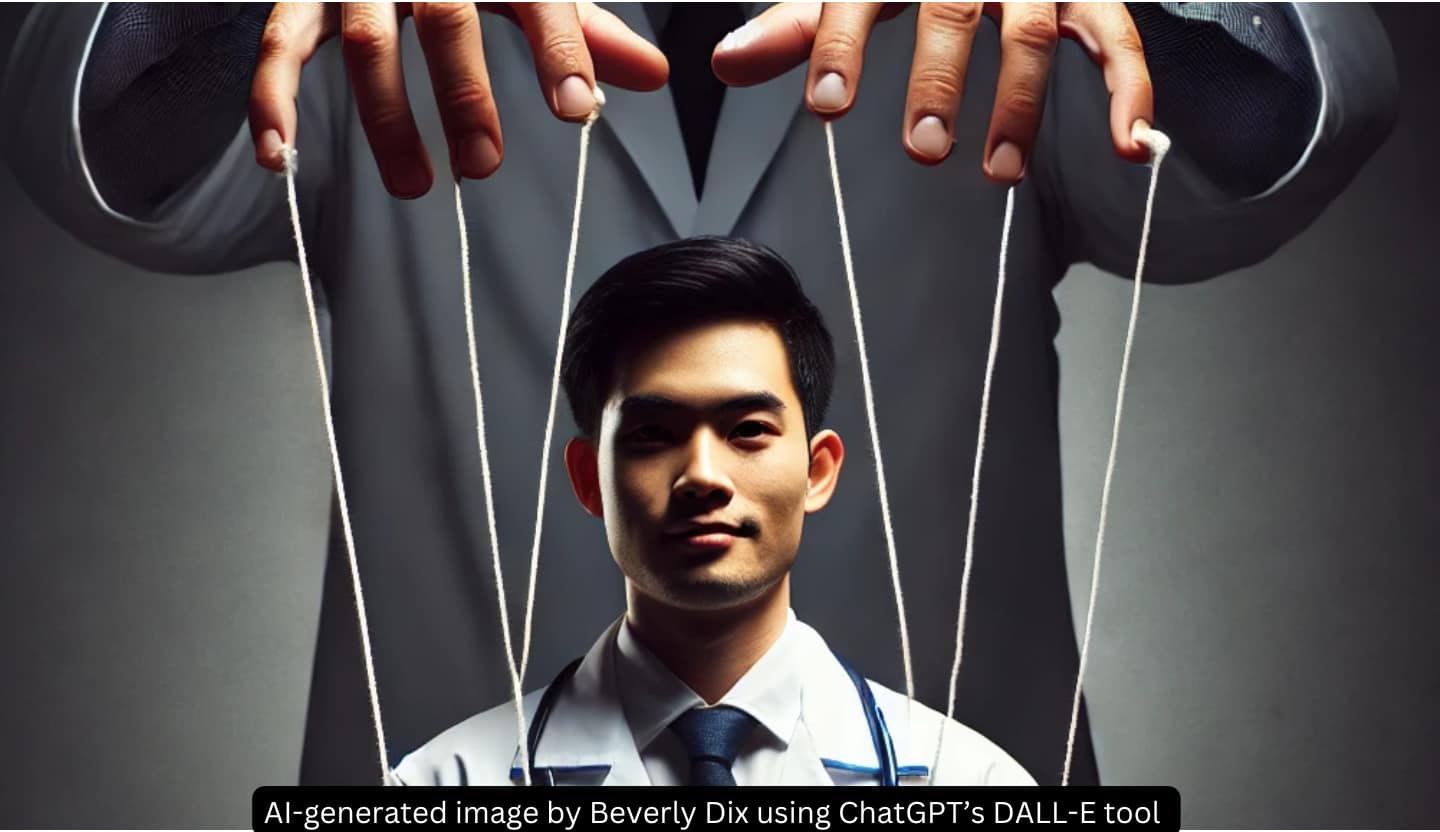
Dr. Choi likens physicians practicing in managed care settings to cogs in a wheel, where their performance indicators focus entirely on profitability and productivity metrics.
Decisions in our modern healthcare delivery systems are based on how they affect profitability. By restricting choice, contradicting medical decisions, limiting physician control, and restricting open communication with patients, the relationship between doctors and their patients has been damaged and compromised.
Therefore, I argue that advancing health literacy among the aging U.S. population is more important than ever—not trust in doctors.
A Case in Point: Mr. Brown
After my neighbor (who I will call Mr. Brown) retired, he became socially isolated. He also gained a considerable amount of weight, which I attributed to his consumption of beer and pizza I often saw him carrying.
Recently, an ambulance came to Mr. Brown’s home. He had fallen and been down for several days. When EMTs brought him out on a stretcher, bystanders commented that his feet appeared massively swollen, and the skin had turned black and green.
Mr. Brown had diabetic gangrene.
Did Mr. Brown have a relationship with a doctor or healthcare provider he trusted? I would guess he did not.
The Transactional Nature of the Doctor-Patient Relationship
The nature of the doctor-patient relationship impacts health outcomes. There is no doubt a collaborative partnership between a patient and their doctor can improve a patient’s medical, functional, and emotional condition.
Unfortunately, in the current iteration of managed care in the U.S., most of us no longer have the luxury of time or access to build trust with our physicians to the degree once enjoyed. The sanctity of the time-honored doctor-patient relationship has been gradually undermined and become disturbingly transactional.
The fact is that during the last 40 years of managed healthcare, the U.S. has experienced a steady uptick in the numbers of Americans developing preventable chronic diseases of lifestyle—including:
✅ Obesity
✅ Diabetes
✅ Heart and respiratory diseases
✅ Certain cancers
According to the Centers for Disease Control (CDC), 42% of Americans have two or more chronic disease conditions.
Evolving Our Expectations of Doctors
It is time to drop our collective defensiveness. The primary care physician-patient relationship, in many instances, no longer builds or sustains the trust required to positively impact the rates at which the aging U.S. population is developing preventable chronic diseases.
Furthermore, it is naïve and disingenuous to envision a bolstering of social and interpersonal trust between doctors and their patients when the profit imperative of managed healthcare business models is centered on throttling costs and increasing shareholder value.
A Call to Action: Why Health Literacy is Critical
According to ChenMed, an organization that specializes in senior medical care, it is estimated that by the year 2034, there will be a shortage of geriatricians due to several factors, including retirement and burnout.
Lack of financial incentive plays a role as well. Geriatricians, on average, earn $20,000 less per year than internists who are not specialists, even though geriatricians must complete a one-year fellowship.
Add to this fact the statistic I cited in my October 2024 article, “Staying Active and Engaged as We Age”—only 1% of doctors are board-certified in geriatric medicine.
Patients’ trust in their healthcare providers has declined over the years, and I do not see this trend reversing under status quo healthcare delivery systems.
Meanwhile, the United States has had a major increase in the number of people suffering from preventable chronic diseases of lifestyle. Most importantly, soon there will be a shortage of physicians available to care for the elderly.
The Future is in Our Hands
A confluence of facts heralds a major healthcare crisis and an overburdening of the U.S. healthcare system.
For these reasons, health literacy—rather than trust in doctors—is more important than ever.
We must take ownership of our health education, choices, and preventative care instead of relying solely on a healthcare system that prioritizes efficiency and profit over relationships and trust.
What Do You Think?
🩺 Do you still trust doctors the way you once did?
📢 Have you noticed a change in the quality of patient care over the years?
💡 How do you advocate for your own health in today’s healthcare system?
Let’s start a conversation in the comments below. 👇
References
📌 Smith, T.M. (April 24, 2024). American Medical Association Affiliated Groups.
📌 Mechanic, D. (1996). The impact of managed care on patients’ trust in medical care and their physicians. JAMA: The Journal of the American Medical Association (Link).
📌 ChenMed (2024). Geriatrician Shortage and Its Impact on Senior Care.
📌 Centers for Disease Control and Prevention (CDC). Chronic Disease Data & Statistics.